Multi-Generational Play: How Snug Play Adapts to Every Age and Ability
- Fiona Hudson
- 8 hours ago
- 3 min read

In public play spaces, children’s museums, and community parks, one of the greatest design hurdles is creating an environment that engages multiple age groups simultaneously.
Standard playgrounds are typically divided by rigid age categories, often leaving families separated or leaving older children feeling under-stimulated while younger siblings explore.
Dynamic, loose-parts systems change the entire playground dynamic. A museum facilitator recently shared their perspective on how Snug Play equipment bridges these age gaps, providing layered, evolving play experiences that bring families and strangers together.
Here is how flexible playground design meets the physical, cognitive, and social needs of every child:
Appealing to the Whole Family Grouping
True inclusion means designing a space where a toddler and a ten-year-old can safely occupy the exact same footprint while extracting completely different play values.
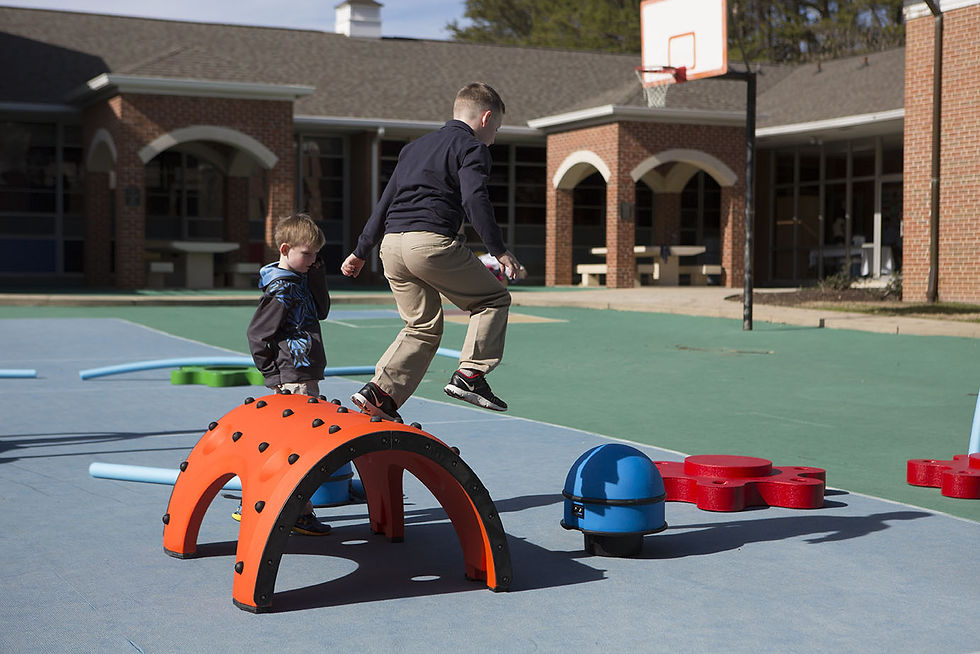
As the facilitator observed: “The thing that’s so great about Snug is it can appeal to a whole family grouping. You have the toddlers that may just be crawling around and on and through and under things, but you have the capacity for kids 10 and up to move pieces and create pieces.”
Because the modular elements are lightweight yet structurally substantial, they support a full spectrum of developmental milestones—from sensory-seeking infants practicing gross motor control to older children executing complex physical builds.
Bridging Social Gaps Through Mixed Play Styles
Playgrounds are critical environments for social development, but children don’t all interact with their surroundings in the same way. Loose-parts play accommodates every stage of social play—from side-by-side exploration to deep group collaboration. “I also like the way that kids can interact with it and do parallel play, cooperative play, and they may not even know the child that they’re next to and playing with.” Whether a child prefers quiet, independent “parallel play” or wants to actively build with a new group of friends, the abstract nature of Snug Play serves as a natural social facilitator. It gives children a shared objective, organically removing social friction and creating spontaneous connections.
Merging Gross Motor Activity with Cognitive Problem Solving
Many traditional playground structures focus purely on physical exertion—climbing, swinging, or sliding. While vital, these static designs rarely challenge a child’s creative thinking or cognitive adaptability. “Kids can get all of their physical needs met with it, but they’re also using their minds with problem solving… They’re not actually going to create a building with it; they’re going to have to imagine what the building looks like and then create it.” When interacting with Snug Play’s open-ended shapes, children have to actively conceptualise a structure in their minds, evaluate the loose pieces available, and figure out how to arrange them. This unique intersection of physical play and imaginative problem solving offers the best of both worlds, keeping the experience entirely fresh every single time a family returns.
The Takeaway
When playground equipment moves away from rigid, predetermined structures and embraces dynamic, user-driven design, it ceases to be just an exhibit—it becomes an evolving canvas. Snug Play proves that when you give children the freedom to manipulate their environment, you unlock a multi-layered play experience that grows alongside them.
Every visit is different. Every age group finds value. Every child belongs.
Join the Conversation
Have you noticed a difference in how your children engage with loose-parts playgrounds versus traditional structures? We’d love to hear your experiences in the comments below!
Interested in optimising your space for multi-generational play? Explore our loose-parts playground solutions here.
Watch the full discussion on playground facilitation and Snug Play in the video above.


Comments