Overcoming Anxiety in Play: An Inclusion Coordinator’s Review of Snug Play
- Fiona Hudson
- Jun 9
- 3 min read

For children with special needs, traditional playgrounds can sometimes feel exclusive or overwhelming. When play structures are fixed and predetermined, children who face physical, social, or behavioral challenges often stand back, relying heavily on adults for support or avoiding the space altogether. True playground inclusion means removing that performance anxiety and replacing it with immediate comfort.
Alison Thompson, a family and classroom coordinator specialising in behavior and inclusion support, recently evaluated a Snug Play installation. Her professional observations offer an incredible look into how loose-parts play equipment breaks down barriers and invites children of all abilities to instinctively step forward.
Here are three ways Snug Play fosters natural inclusion and higher-order engagement:
Replacing Hesitation with Instant, Autonomous Engagement
For children who struggle with anxiety or look to adults to navigate social settings, entering a bustling play area can induce stress. However, when children are given a space where they control the environment, that dynamic changes completely.
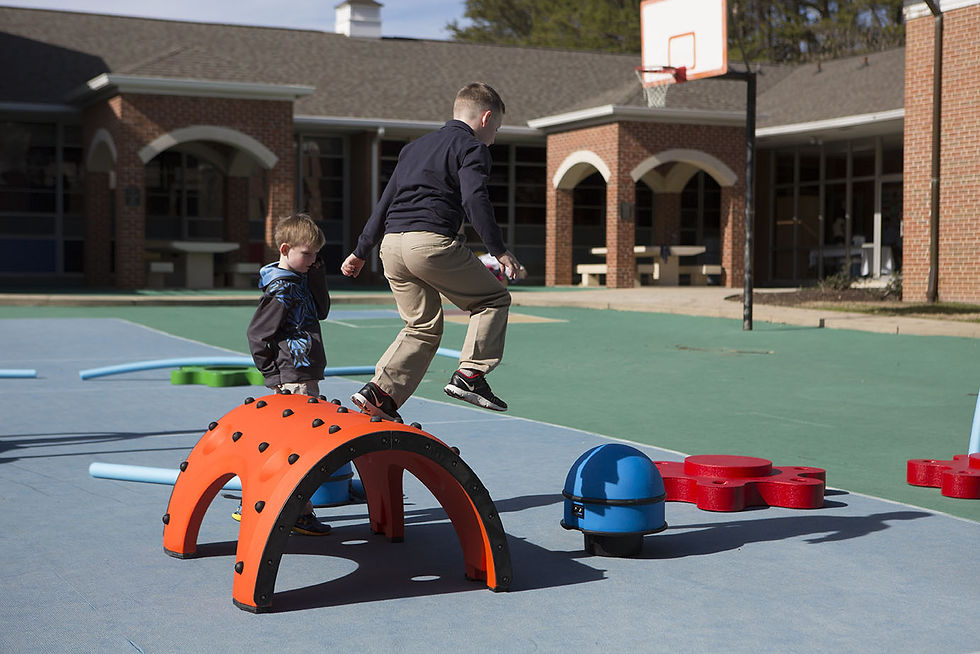
As Alison observed: “One of the things that I think was most exciting was some of our kids who, they kind of have a tendency to lean on an adult for support or stand back—they came in, they saw everything that was here, and they immediately started interacting.”
Because the equipment is bright, abstract, and non-prescriptive, it doesn’t give children a rigid set of rules to follow. This eliminates the fear of “doing it wrong,” allowing anxious children to open up and naturally engage without waiting for an adult’s permission or guidance. When children feel empowered to explore on their own terms, anxiety dissolves. They stop looking over their shoulders for approval and start trusting their own instincts.
Inspiring Spontaneous Peer Support and Teamwork
When playground equipment is modular and requires moving parts, it creates an organic necessity for collaboration. Children naturally begin coordinating to achieve their play goals, bridging gaps between children with special needs and their neurotypical peers.
“It was really nice to see that everyone was working together. They were working together to move the pieces back and forth to help their friends… the children with disabilities were being supported by their peers to play with the pieces. And they weren’t anxious about it.”
This peer-to-peer interaction removes social friction. Rather than noticing differences or disabilities, children focus entirely on the objective of the game—helping each other move shapes, build structures, and play together as equals. What makes this particularly powerful is that the support happens naturally, not through forced inclusion activities. The equipment itself creates the conditions where helping becomes intuitive and mutual respect emerges organically.
Adapting to Diverse Learning Styles and Motivations
Every child processes information, retains focus, and experiences motivation differently. Static playground equipment typically caters strictly to gross motor activity. Snug Play, by contrast, simultaneously captures both physical and cognitive interests.
“Every child learns differently and everyone has so many things that motivate them. If it’s the gross motor piece that’s motivating to you, then you’re jumping, you’re climbing, you’re running… but some of us that’s not the way that we learn, so they come to it and its creation… It’s a slide if you want it to be a slide, it’s a castle if you want it to be a castle.”
Whether a child is driven by high-energy physical exertion or the quiet, focused problem-solving of structural creation, the equipment adapts seamlessly to meet them where they are. This open-ended flexibility nurtures vital developmental traits like persistence, resilience, and higher-order imaginative thinking. Children with sensory processing differences, attention challenges, or learning disabilities find their entry point. There’s no single “correct” way to engage, which means every child can succeed.
The Takeaway
When playground design steps away from fixed structures and moves toward user-manipulated systems, it transforms into an evolving canvas for development. Snug Play proves that by giving children total control over their surroundings, we don’t just provide accessible play—we foster peer interaction, eliminate anxiety, and build true inclusion.
Inclusion isn’t about retrofitting children into existing spaces. It’s about designing spaces that naturally invite every child to belong.
Share Your Experience
Have you seen loose-parts systems like Snug Play help an anxious or reserved child open up to their peers? Tell us your story in the comments below!
Watch Alison’s full testimonial and see Snug Play in action in the video above.


Comments